

The Complete Beginner Trading System: Rules, Risk, Psychology & Execution
Why Most Beginner Traders Lose Money
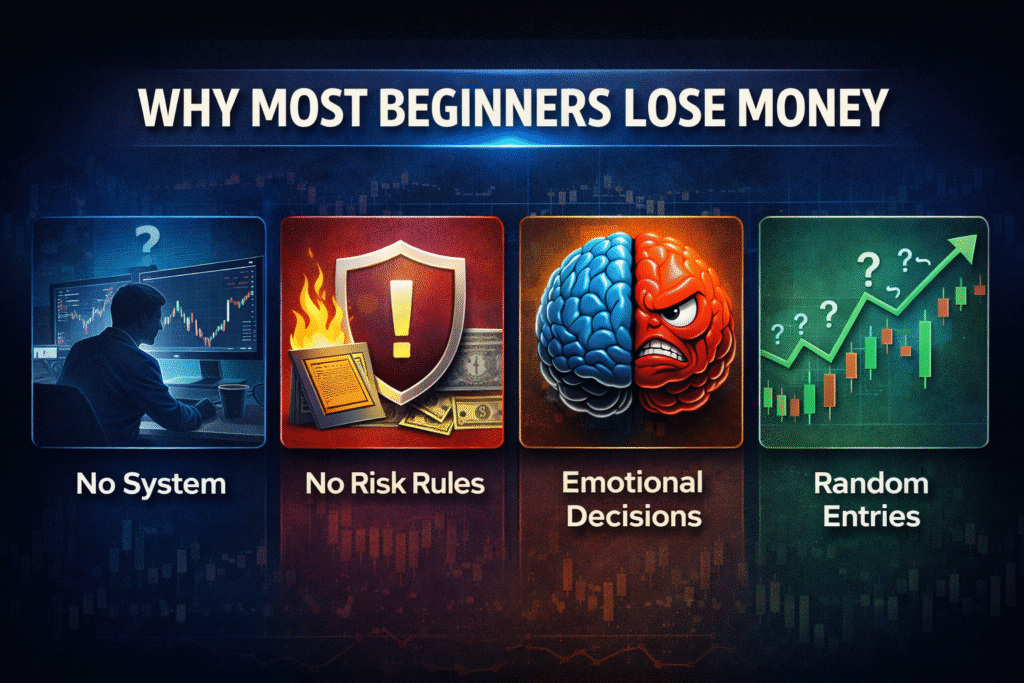
Most beginner traders don’t lose money because the market is “rigged” or because they chose the wrong indicator. They lose money because they trade without a system.
New traders jump from strategy to strategy, chasing signals, indicators, and YouTube setups. One day it’s RSI, the next day it’s MACD, then price action, then options, then futures. The problem isn’t a lack of information — it’s lack of structure.
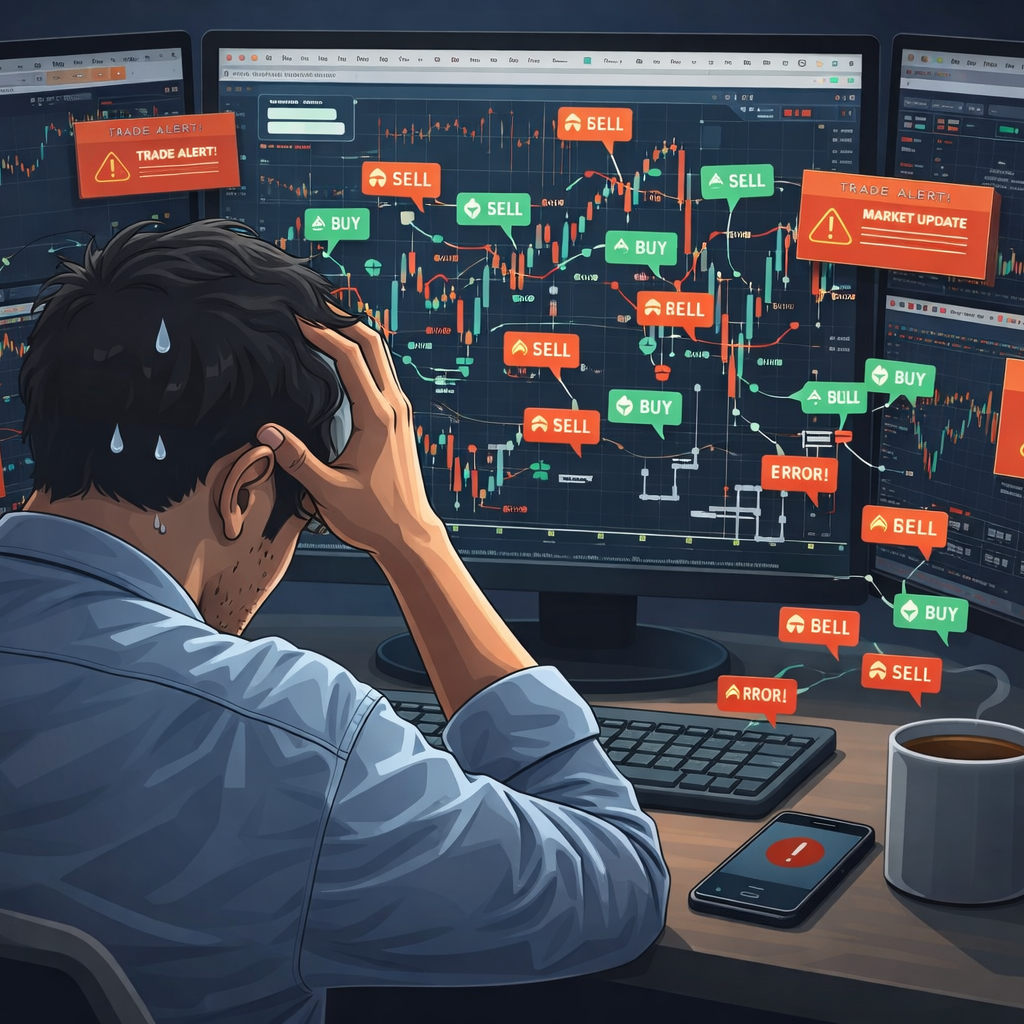
Without clear rules, every trade becomes an emotional decision. Fear after losses, greed after wins, and revenge trading after drawdowns slowly destroy consistency. Even a good strategy fails when it’s executed without discipline and risk control.
Professional traders don’t rely on predictions. They rely on systems.
A trading system tells you:
- When to trade
- When not to trade
- How much to risk
- When to exit
- When to stop trading for the day
This article will show you how a complete beginner trading system actually works — step by step. You’ll learn why structure matters more than strategy, how risk management keeps you in the game, and why psychology decides long-term success.
This is not about getting rich quick.
This is about learning to trade the right way.
Why Most Beginners Lose Money
Most beginners lose money by overtrading, chasing indicators, ignoring risk, and letting emotions control decisions. Without rules, patience, and discipline, even good strategies fail consistently.
What Is a Trading System?
A trading system is a set of predefined rules that tells you exactly how to trade — without guessing, improvising, or reacting emotionally.
It removes decision-making during the trade and replaces it with structure before the trade.
A real trading system answers five critical questions:
- What market should I trade?
- When am I allowed to enter?
- Where is my stop loss?
- Where will I take profit?
- When should I stop trading for the day?
If any of these answers are missing, you don’t have a system — you have opinions.
A System Has 4 Non-Negotiables
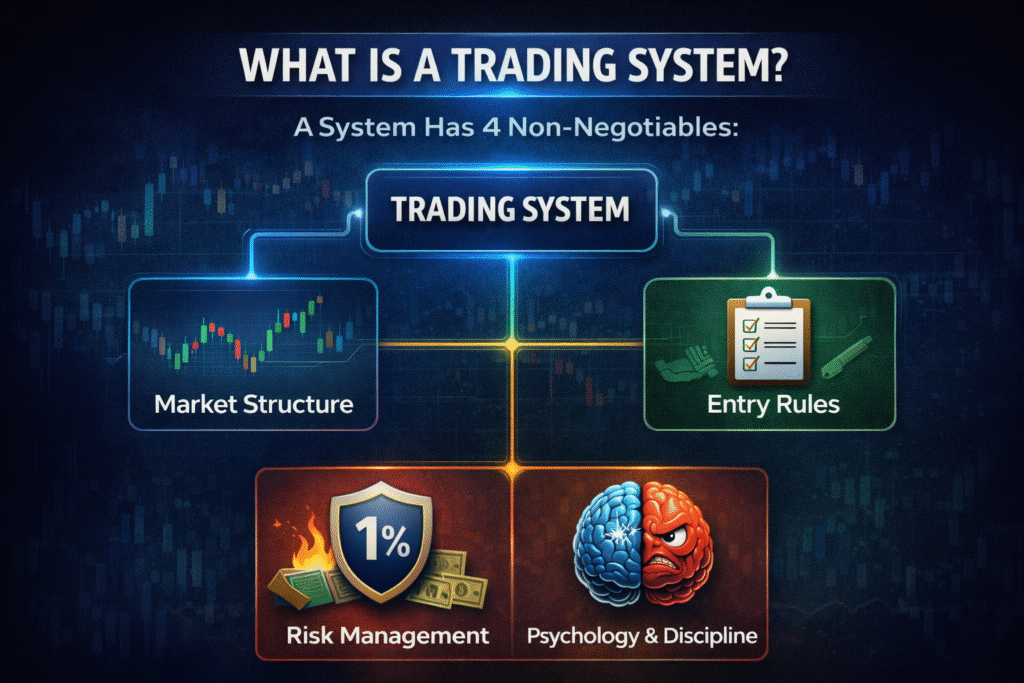
Every consistent trading system — regardless of strategy or timeframe — is built on four core pillars:
- Market Structure
- Understanding whether price is trending up, trending down, or ranging.
- You trade with structure, not against it.
- Entry Rules
- Clear conditions that must be met before entering a trade.
- No rules = overtrading and chasing candles.
- Risk Management
- How much you risk per trade and where you exit if you’re wrong.
- This is what keeps you in the game long enough to learn.
- Psychology & Discipline
- Your ability to follow the system consistently — especially after losses.
- Most traders fail here, not at strategy.
If one pillar is weak, the entire system collapses.
Strategy vs System (Critical Difference)
Most beginners focus only on strategy — entries, indicators, setups.
Professional traders focus on systems.
- strategy tells you where to enter
- A system tells you how to survive
You can have an average strategy and still succeed with strong risk and discipline.
But even the best strategy will fail without structure and consistency.
Why Beginners Need Systems First
Beginners don’t need complexity. They need clarity.
A simple system:
- Reduces emotional decisions
- Limits overtrading
- Makes mistakes visible
- Creates repeatable behavior
Once behavior is consistent, results improve naturally.
Transition to Next Section
Now that you understand what a trading system is, the next step is learning how price actually moves — because every rule you use depends on market structure.
1% Rule in Trading
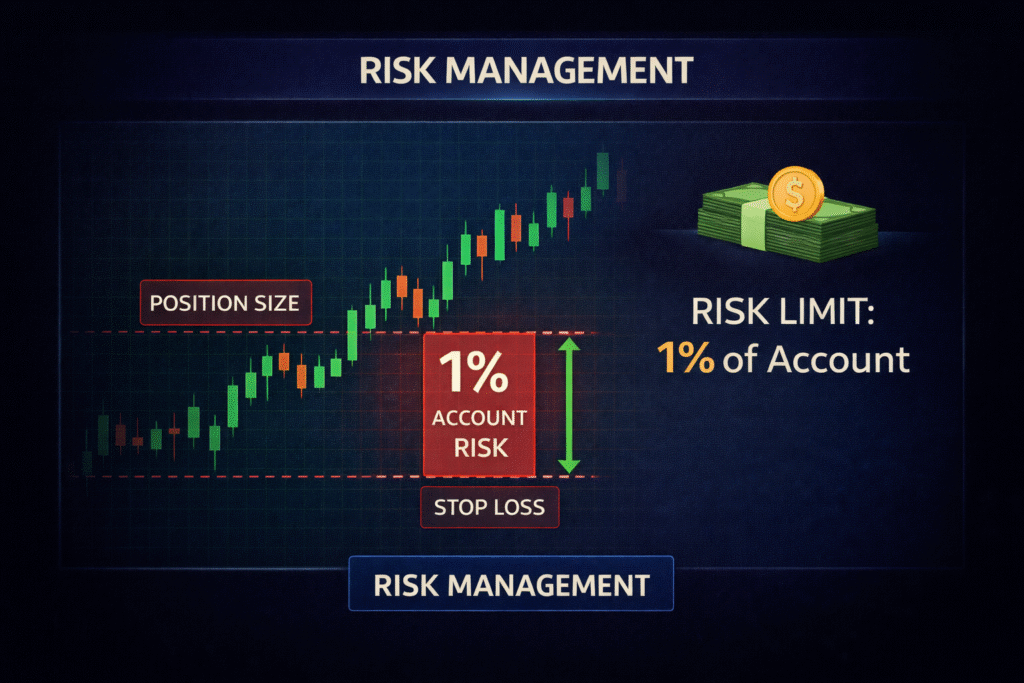
The 1% rule limits risk per trade to protect capital, reduce emotional pressure, and ensure survival during losing streaks, allowing traders to stay consistent and grow steadily over time.
Market Structure: Trading With the Trend
Before thinking about entries, indicators, or strategies, you must understand market structure.
Without it, you’re trading blind.
Market structure simply describes who is in control — buyers or sellers — and how price is moving over time.
Every market does only three things:
- Trends up
- Trends down
- Moves sideways (range)
Your job is not to predict.
Your job is to identify.
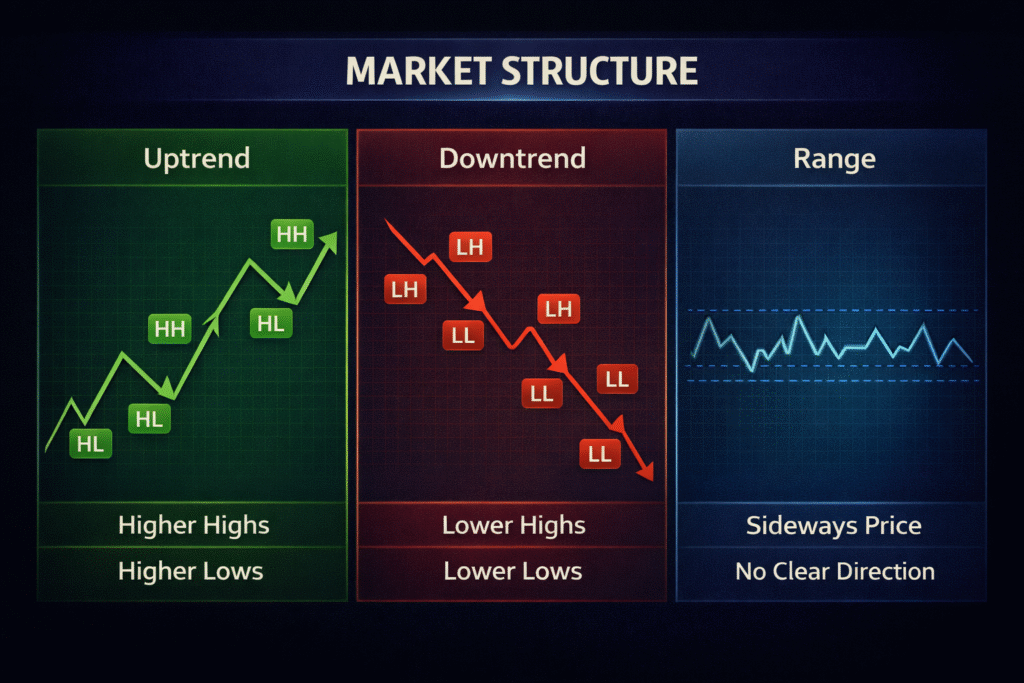
The Three Types of Market Structure
1. Uptrend (Bullish Structure)
An uptrend is formed when price makes:
- Higher Highs (HH)
- Higher Lows (HL)
This tells you buyers are in control.
Rule for beginners:
Only look for long trades in an uptrend.
Trying to short an uptrend is fighting momentum — and momentum usually wins.
2. Downtrend (Bearish Structure)
A downtrend is formed when price makes:
- Lower Highs (LH)
- Lower Lows (LL)
This tells you sellers are in control.
Rule for beginners:
Only look for short trades in a downtrend.
Buying dips in a downtrend feels “cheap” — but cheap can always get cheaper.
3. Range (No Clear Structure)
A range occurs when:
- Price is moving sideways
- Highs and lows are overlapping
- There is no clear trend
This is where most beginners lose money.
Rule for beginners:
When structure is unclear → don’t trade.
No trade is a position.
Why Structure Matters More Than Indicators
Indicators react to price.
Structure explains price.
If you trade against structure:
- Stop losses get hit more often
- Trades feel random
- Confidence drops quickly
When you trade with structure:
- Trades align with momentum
- Pullbacks make sense
- Entries feel calmer and planned
Structure keeps you on the right side of probability.
Beginner Rule of Thumb
Before every trade, ask one question:
If you can’t answer that in 5 seconds, you shouldn’t be trading.
Transition to Next Section
Once structure is clear, the next step is knowing when to enter — without chasing price or overtrading.
Overtrading & FOMO
Overtrading and FOMO push beginners into low-quality trades, emotional entries, and excessive risk, leading to rapid losses, burnout, and broken discipline instead of patience, selectivity, and consistent execution over time.
Entry Rules: Fewer Trades, Better Trades
Entries are where most beginners lose control.
They see a fast candle, a breakout, or a sudden move — and they click buy or sell without a plan. The result is chasing price, entering late, and getting stopped out quickly.
Good traders don’t trade more.
They trade better.
Entry rules exist to filter bad trades, not to increase activity.
What Entry Rules Actually Do
Entry rules are conditions that must be met before a trade is allowed.
They protect you from:
- Overtrading
- FOMO entries
- Revenge trades
- Random clicking
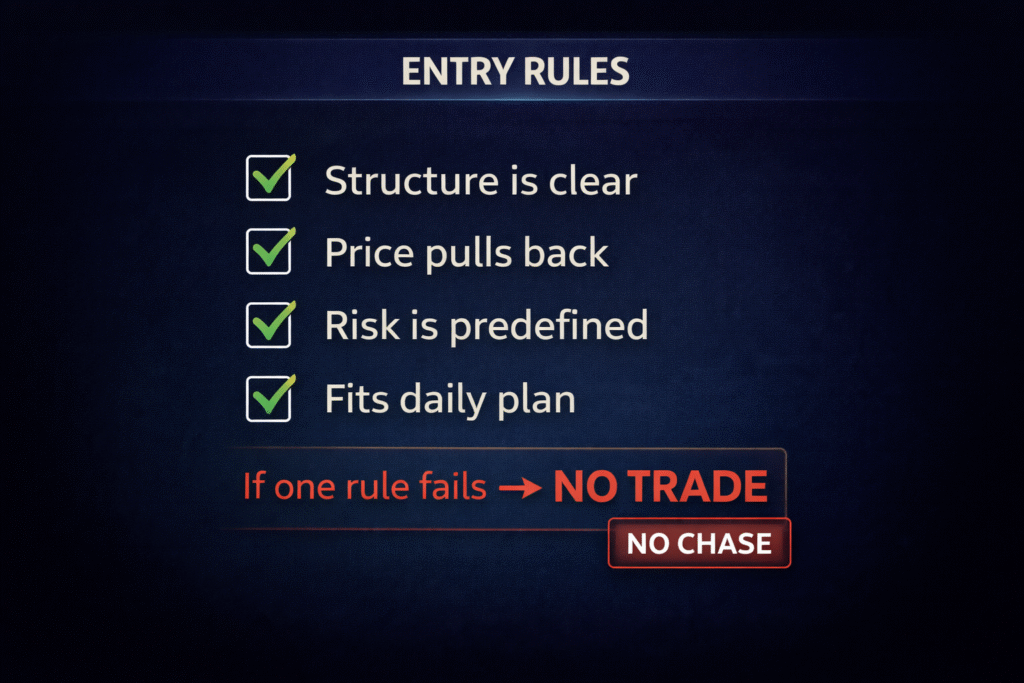
If rules are not met, no trade happens — no matter how tempting it looks.
Beginner-Friendly Entry Rules (Example)
A simple entry rule set might look like this:
- Market structure is clear (uptrend or downtrend)
- Price pulls back, not extended
- Entry aligns with the trend
- Risk is predefined before entry
- Trade fits your daily plan
Skipping trades is part of discipline.
Why Beginners Should Avoid Chasing Candles
Big candles create urgency and emotion.
By the time you see a large move:
- Risk increases
- Stop loss widens
- Probability decreases
Professional traders wait for confirmation, not excitement.
If you missed the move, you missed it.
There will always be another trade.
Less Trading = More Consistency
Most beginners believe more trades mean more profits.
In reality:
- More trades = more mistakes
- Fewer trades = higher quality decisions
One well-planned trade is better than five emotional ones.
Entry Rules Reduce Emotional Stress
When rules are clear:
- You stop second-guessing
- Losses feel controlled
- Wins feel repeatable
You are no longer reacting to the market — you are executing a plan.
Transition to Next Section
Once entry rules are clear, the next question becomes critical:
That’s where risk management decides whether you survive or blow up.
Trading Psychology
Most beginner traders believe success comes from finding the perfect strategy. They spend months jumping between indicators, setups, and YouTube systems—yet results don’t improve.
Risk Management: The 1% Rule
Risk management is the difference between traders who survive and traders who blow up.
You can be wrong many times and still succeed — if your risk is controlled.
But one undisciplined trade can erase weeks of progress.
That’s why professional traders focus on risk first, not profits.
What the 1% Rule Means
The 1% Rule means you never risk more than 1% of your trading account on a single trade. Example:
- Account size: $5,000
- Maximum risk per trade: $50
- If the trade hits your stop loss, you lose $50 — not more.
This rule applies before you enter the trade, not after.
Why the 1% Rule Works
Losses are part of trading.
The goal is to make sure losses are small and manageable.
When you risk too much:
- Emotions increase
- Fear affects decisions
- Revenge trading begins
- Accounts blow up quickly
When risk is limited:
- Losses feel controlled
- You stay calm
- You follow your rules
- Consistency becomes possible
Risk control protects your mind, not just your money.
Stop Loss Is Not Optional
A stop loss is not a suggestion.
It is part of the trade.
Every trade must have:
- Entry price
- Stop loss price
- Defined risk amount
If you don’t know where your stop loss is, you shouldn’t be in the trade.
Moving or removing stop losses is how most beginners destroy their accounts.
Position Size Comes From Risk, Not Confidence
Beginners often ask:
That is the wrong question.
The correct process is:
- Decide where your stop loss goes
- Decide how much you’re willing to risk (1%)
- Calculate position size from those two numbers
Confidence has nothing to do with position size.
Rules do.
Small Losses Create Long-Term Survival
You don’t need to win big.
You need to lose small.
A trader who loses 1% repeatedly can:
- Learn from mistakes
- Stay in the game
- Improve execution
- Grow slowly and safely
A trader who risks 10–20% per trade eventually reaches zero.
Transition to Next Section
Even with perfect risk rules, trading is still emotional.
The final challenge is not the market —
it’s you.
Download the Free Trading Checklist
Download a free, beginner-friendly trading checklist to help you follow rules, control risk, avoid emotional trades, and build discipline before every trade.
Psychology: Discipline Beats Strategy
Most traders don’t fail because they lack knowledge.
They fail because they can’t control their behavior under pressure.
You can have a solid system, good entries, and perfect risk rules — and still lose money if emotions take over.
Trading psychology is not about being fearless.
It’s about following rules even when emotions are loud.
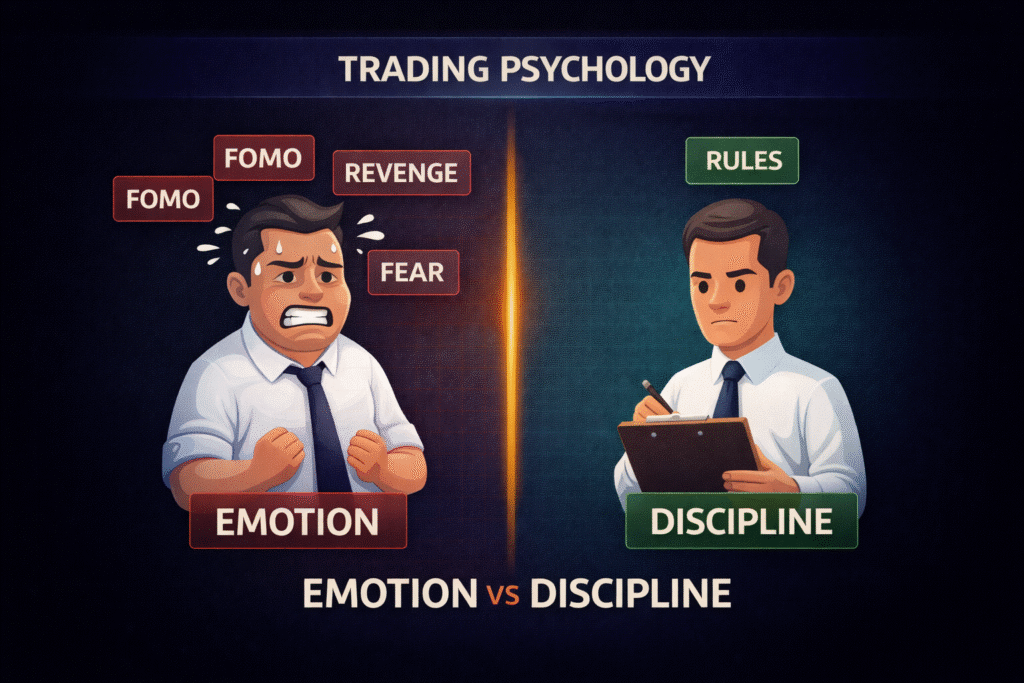
The Four Emotions That Destroy Trades
Every beginner experiences these emotions. The problem starts when they control decisions.
- Fear causes early exits, hesitation, and missed trades.
- Greed pushes traders to overtrade, oversize, and hold losers too long.
- FOMO leads to chasing candles and entering late.
- Revenge trading happens after a loss, when logic is replaced by emotion.
These emotions are normal. Acting on them is what causes damage
Why Discipline Matters More Than Strategy
A good strategy executed poorly will fail.
A simple strategy executed with discipline can succeed.
Discipline means:
- Taking only planned trades
- Respecting stop losses
- Stopping after daily limits
- Skipping trades that don’t meet rules
Professional traders don’t focus on how much money a trade might make. Instead, they judge success by whether they followed their rules and executed their plan correctly, knowing that consistent execution is what produces long-term results.
Discipline Is Built Outside the Trade
You cannot “be disciplined” in the moment.
Discipline is created before trading:
- Written rules
- Daily routines
- Risk limits
- Journaling
Once the trade is live, your job is not to think — it’s to execute.
Losses Are Not the Problem
Losses are part of the business.
The real damage happens when:
- One loss turns into five trades
- One mistake turns into a blown account
- One emotional day wipes out weeks of progress
Disciplined traders accept losses and move on.
Transition to Next Section
Discipline improves when mistakes are visible.
That’s where journaling becomes the most powerful tool for growth.
Risk Management: The 1% Rule
Risk management is the difference between traders who survive and traders who blow up.
You can be wrong many times and still succeed — if your risk is controlled.
But one undisciplined trade can erase weeks of progress.
That’s why professional traders focus on risk first, not profits.
What the 1% Rule Means
The 1% Rule means you never risk more than 1% of your trading account on a single trade. Example:
- Account size: $5,000
- Maximum risk per trade: $50
- If the trade hits your stop loss, you lose $50 — not more.
This rule applies before you enter the trade, not after.
Why the 1% Rule Works
Losses are part of trading.
The goal is to make sure losses are small and manageable.
When you risk too much:
- Emotions increase
- Fear affects decisions
- Revenge trading begins
- Accounts blow up quickly
When risk is limited:
- Losses feel controlled
- You stay calm
- You follow your rules
- Consistency becomes possible
Risk control protects your mind, not just your money.
Stop Loss Is Not Optional
A stop loss is not a suggestion.
It is part of the trade.
Every trade must have:
- Entry price
- Stop loss price
- Defined risk amount
If you don’t know where your stop loss is, you shouldn’t be in the trade.
Moving or removing stop losses is how most beginners destroy their accounts.
Position Size Comes From Risk, Not Confidence
Beginners often ask:
That is the wrong question.
The correct process is:
- Decide where your stop loss goes
- Decide how much you’re willing to risk (1%)
- Calculate position size from those two numbers
Confidence has nothing to do with position size.
Rules do.
Small Losses Create Long-Term Survival
You don’t need to win big.
You need to lose small.
A trader who loses 1% repeatedly can:
- Learn from mistakes
- Stay in the game
- Improve execution
- Grow slowly and safely
A trader who risks 10–20% per trade eventually reaches zero.
Transition to Next Section
Even with perfect risk rules, trading is still emotional.
The final challenge is not the market —
it’s you.
A Simple Beginner Trading System (Example)
You don’t need a complex strategy to start trading correctly.
You need a simple system that you can follow consistently.
Below is an example of a beginner-friendly trading system that combines everything you’ve learned in this article.
Step 1: Market Selection
- Trade one market only (example: SPY, QQQ, or one stock)
- One market = fewer variables = faster learning
Step 2: Market Structure Rule
- Trade long only in an uptrend
- Trade short only in a downtrend
- No trades in sideways markets
If structure is unclear, the trade is skipped.
Step 3: Entry Rules
- Price pulls back in the direction of the trend
- Entry aligns with structure
- No chasing breakouts
- Risk is defined before entry
If one rule fails → no trade
Step 4: Risk Management
- Risk 1% of account per trade
- Stop loss placed before entry
- Position size calculated from risk, not emotion
One trade should never damage the account.
Step 5: Trade Limits
- Maximum 1–2 trades per day
- Stop trading after one full stop-loss hit
- No revenge trades
Discipline increases when trading frequency decreases.
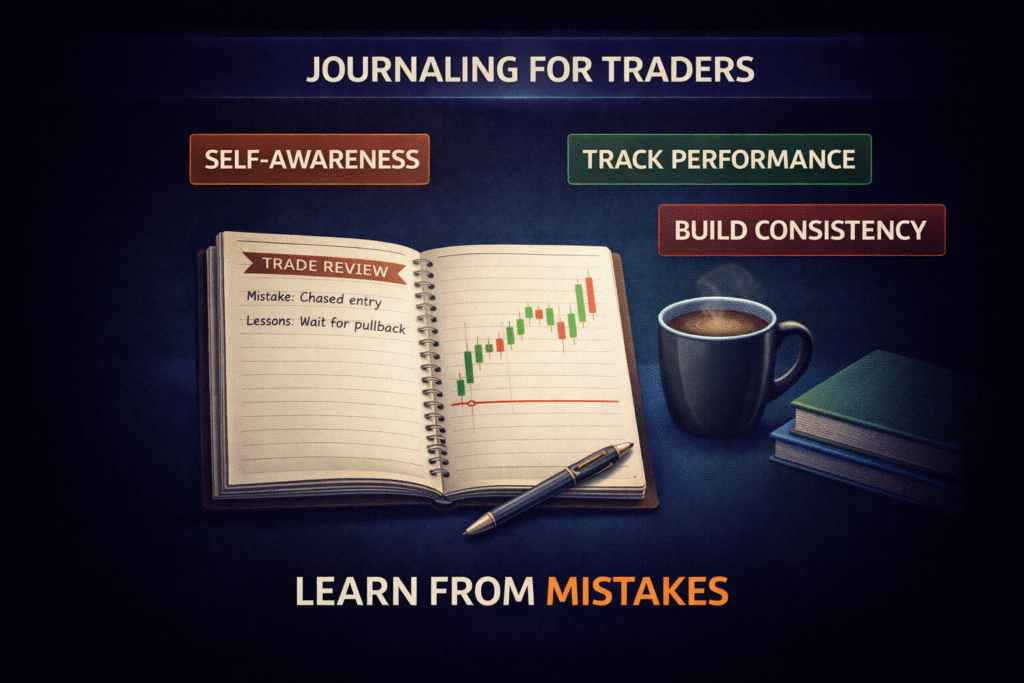
Step 6: Post-Trade Journaling
After each trade, write:
- Did I follow my rules?
- What went well?
- What needs improvement?
The goal is execution quality, not profit alone.
Why This System Works for Beginners
This system:
- Reduces emotional decisions
- Protects capital
- Builds consistency
- Creates measurable improvement
- Scales as experience grows
It doesn’t promise fast money.
It builds professional habits.
Final Thought
Winning traders don’t chase profits.
They design systems that make profits a by-product of discipline.
If you master structure, risk, psychology, and journaling, you’re already ahead of most traders.
Beginner Trading Insights
Overtrading & FOMO: The Silent Account Killers for Traders
Overtrading & FOMO: The Silent Account Killers for Traders Many traders don’t lose money because…

Can You Make $1,000 Per Day Trading? The Honest Truth
Can You Make $1,000 Per Day Trading? The Honest Truth Can you make 1000 per…

Trading Psychology: Why Discipline Matters More Than Strategy
Trading Psychology: Why Discipline Matters More Than Strategy Most beginner traders believe success comes from…
Why Most Beginners Lose Money
Why Most Beginners Lose Money in Trading If trading was as easy as buying and…