
The 1% Rule in Trading
A Beginner’s Guide to Risk Management That Actually Works
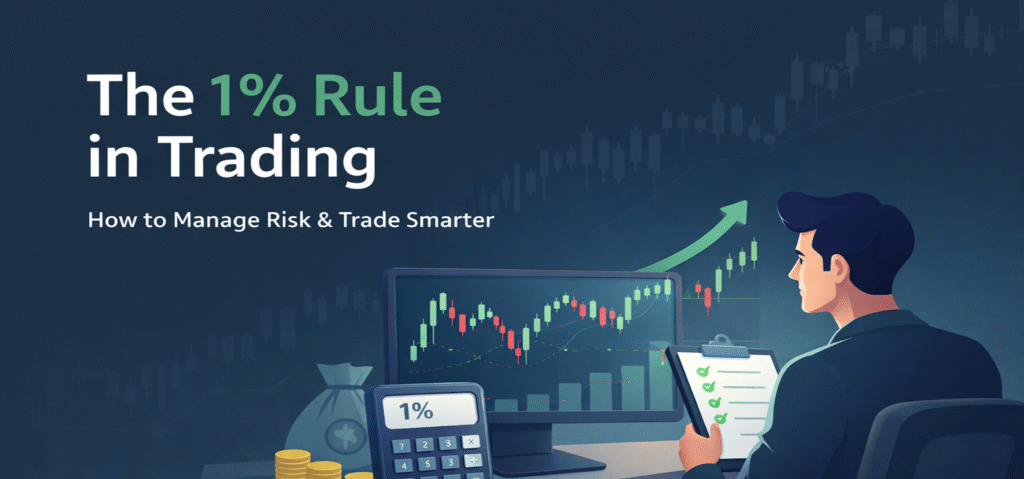
The 1% rule in trading helps beginners control losses and stay consistent by limiting how much capital is risked on each trade. Most beginner traders don’t lose money because their strategy is bad — they lose because they risk too much on a single trade.
The 1% rule in trading is a simple risk management principle that means you never risk more than 1% of your trading account on a single trade, no matter how confident you feel.
One emotional trade, one oversized position, or one ignored stop-loss can undo weeks of progress. That’s why professional traders follow this rule — it protects both the trading account and the trader’s mindset, helping them survive long term.
The 1% Rule.
In this guide, you’ll learn what the 1% rule really means, why it works, and how to apply it correctly in real trading — even with a small account.
What Happens If You Break the 1% Rule?
Breaking the 1% rule usually doesn’t fail immediately—it fails over time. A few oversized losses can erase multiple good trades and push you into emotional decisions like revenge trading or moving your stop-loss. The goal isn’t to avoid losses; it’s to keep every loss small enough that you can continue trading with a clear mind and follow your process. Consistency comes from surviving bad streaks without blowing up your account.
Why the 1% Rule Works
The 1% rule isn’t about being conservative — it’s about survival and consistency.
Here’s why it works so well:
- Protects your capital
- You can be wrong multiple times and still stay in the game.
- Stabilizes emotions
- Smaller losses mean less fear, less revenge trading, and clearer thinking.
- Gives you more learning opportunities
- Trading is a skill. You need many attempts to improve — not account blow-ups.
Professional traders think in terms of risk first, not profits. This is also covered in our Trading Psychology module.
The Simple Formula (With Examples)
- Calculate 1% Risk
- Account Balance × 1% = Maximum Risk Per Trade
- Use Your Stop-Loss Distance
- Your position size depends on:
- Entry price
- Stop-loss price
- Risk amount (1%)
- Your position size depends on:
Use a position size calculator to double-check the math.
Example 1: Small Account
If your stop-loss is $0.50 away:
$50 ÷ $0.50 = 100 shares
If the stop is hit → loss = $50 (exactly 1%)
Example 2: Larger Account
Stop-loss distance: $2.00
$200 ÷ $2.00 = 100 shares
Same logic. Different scale. Same discipline.
Common Mistakes Beginners Make
Many traders think they’re following the 1% rule — but they’re not.
Avoid these mistakes:
- Risking 1% without a stop-loss
- Increasing position size to “make it back”
- Moving the stop-loss after entry
- Confusing position size with risk
- Averaging down on a losing trade
Remember:
Your stop-loss defines your risk.
No stop = unlimited risk.
1% Rule in Real Life Trading
As a beginner, you can be even more conservative:
- 0.5% risk → while learning
- 1% risk → once consistent
- ❌ More than 1% → only for advanced traders with strict rules
There is no rush. Trading rewards patience, not aggression.
Quick Checklist Before Every Trade
Before you enter any trade, ask yourself:
- Where is my entry?
- Where is my stop-loss?
- How much am I risking in dollars?
- Does this equal 1% or less of my account?
- If the stop hits, can I walk away calmly?
If the answer is no — don’t take the trade.
Final Thoughts
The 1% rule won’t make you rich overnight.
What it will do is something far more important:
It will keep you alive, disciplined, and emotionally stable long enough to become a real trader.
Risk management isn’t optional.
It’s the foundation everything else is built on.
Related Reading to Strengthen Your Trading Discipline
Why Most Beginners Lose Money
Most beginners lose money by overtrading, chasing indicators, ignoring risk, and letting emotions control decisions. Without rules, patience, and discipline, even good strategies fail consistently.
Trading Psychology
Most traders don’t fail due to bad strategies—but poor discipline. Emotional decisions, overtrading, and inconsistency destroy results. Psychology and disciplined habits matter far more than finding the “perfect” setup.
Overtrading & FOMO
Overtrading and FOMO push beginners into low-quality trades, emotional entries, and excessive risk, leading to rapid losses, burnout, and broken discipline instead of patience, selectivity, and consistent execution over time.
Beginner Trading Insights

The Complete Beginner Trading System: Rules, Risk, Psychology & Execution
The Complete Beginner Trading System: Rules, Risk, Psychology & Execution Why Most Beginner Traders Lose…
Overtrading & FOMO: The Silent Account Killers for Traders
Overtrading & FOMO: The Silent Account Killers for Traders Many traders don’t lose money because…

Can You Make $1,000 Per Day Trading? The Honest Truth
Can You Make $1,000 Per Day Trading? The Honest Truth Can you make 1000 per…

Trading Psychology: Why Discipline Matters More Than Strategy
Trading Psychology: Why Discipline Matters More Than Strategy Most beginner traders believe success comes from…
Why Most Beginners Lose Money
Why Most Beginners Lose Money in Trading If trading was as easy as buying and…
Pingback: Why Most Beginners Lose Money Trading (And How to Avoid It)